Person-centred care plans and digital care records
Move care plans, risk assessments, daily notes and incident records off paper and out of WhatsApp. Every entry is timestamped, attributable and ready when a commissioner, family member or inspector asks.
7-day free trial · No credit card required
What is in the record
One service user record that carers, managers and reviewers all work from.
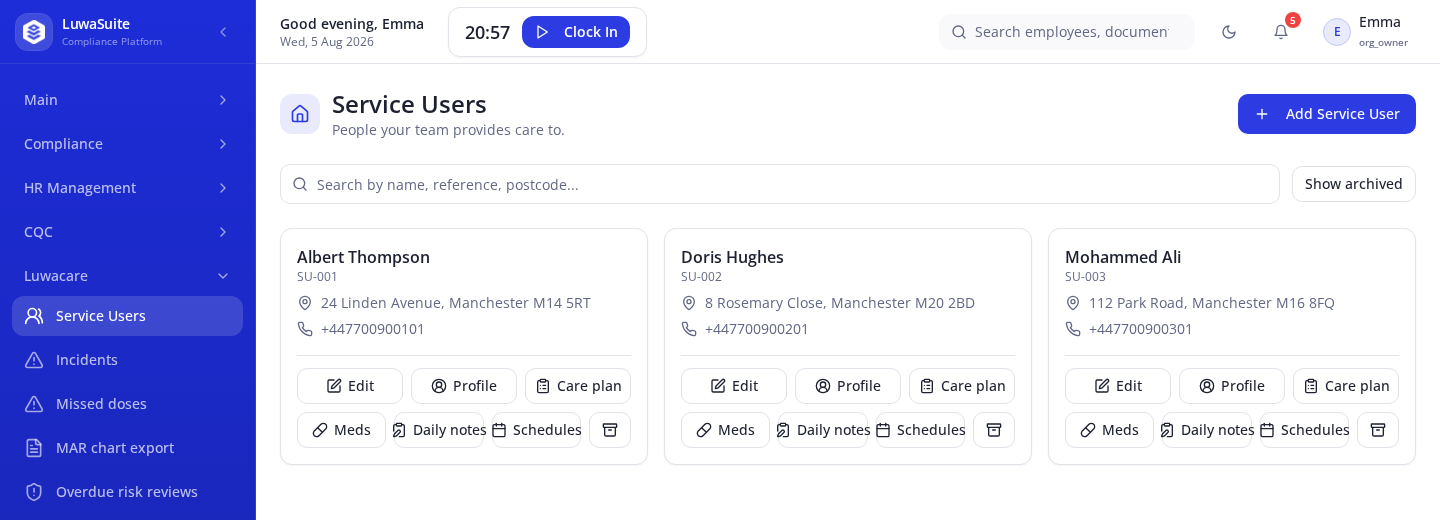
Service user profiles
Personal details, contacts, preferences and an about-me record so every carer sees the same person, not a task list.
Care plans
Build person-centred plans, set review dates, and see overdue reviews across the whole service at manager level.
Risk assessments
Risk flags surface on the profile and in the visit view, so a carer sees them before starting the call.
Visit task checklists
Attach the tasks a visit should deliver, so planned care is evidenced against what was actually done.
Daily notes
Notes recorded against the visit, with a per-service-user daily notes view for managers reviewing the week.
Clinical boundary
Care records use separate clinical role and access-grant controls; HR administration alone does not provide clinical access.
How a care plan becomes everyday work
Step 1
Create a person-centred plan
Add a title, start date and review date. Organise tasks by domains such as personal care, mobility, meals and social support.
Step 2
Make tasks clear
Set instructions, frequency and which tasks are mandatory. Reuse a suitable template and adapt it to the person.
Step 3
Review and keep a history
Review the plan with the responsible team, keep the review details and archive superseded plans rather than relying on an undated document.
Access that fits the team
Clinical records have separate access rules from HR administration. Authorised clinical roles and eligible explicit grants determine access; HR or IT administration alone does not provide clinical access. Include a manager and a care-worker walkthrough in your demo.
Modules, pricing and rollout
Core plans start from £49/month. Care Visits & Service Users and CQC are optional add-ons billed separately. Ask for a written quote confirming your care planning, eMAR, visit and user requirements before choosing a package.
Start with the records and roles you need, configure the workflows, train the team and pilot a small set of visits before a wider rollout. Agree how existing records will be transferred and retained.
Compare core plans and add-onsWhat changes when records go digital
Digital care records are not just paper on a screen — they change what managers can see.
- Overdue care plan reviews are visible before they become a finding
- Risk information reaches the carer at the point of care
- Notes are attributable to a named carer and a specific visit
- Handovers stop depending on someone remembering to pass a message
- Evidence for inspection is already collected, not reassembled
- Care records can be reviewed by authorised staff without locating a paper folder
Part of one platform
This sits alongside Home Office sponsor licence compliance, full HR management and care delivery — one record, one login, one audit trail.
See the full care platformCare planning questions
Is this a digital social care record?
LuwaSuite keeps digital care records — service user profiles, care plans, risk assessments, visit tasks, daily notes, incidents and medication records — in place of paper. We describe it as a digital care record rather than claiming any external assurance status.
Can we build our own care plan structure?
Yes. Care plans are built per service user and can be templated so the same structure is reused across the service.
How do we track care plan reviews?
Each plan carries a review date, and managers have a view of overdue reviews across the service so nothing quietly lapses.
Does it work for domiciliary care?
Yes. Visits carry task checklists and per-visit daily notes, which suits domiciliary and supported living as well as residential services.
Can HR or IT staff see care records?
HR or IT administration alone does not grant clinical access. Authorised clinical roles and eligible explicit grants determine who can view care records.
Does it include incident reporting?
Yes. Incidents are recorded in a structured form with a body map for injuries and falls, and retained as audit evidence.
Put the care record where everyone can use it
Book a care planning walkthrough and review the records, tasks, access and module setup your service needs.
Related Resources
Explore more of the LuwaSuite platform